
When somebody collapses in cardiac arrest outside of hospital, every second counts.
In those first few moments, the actions of ordinary members of the public, workplace First Aiders, family members or complete strangers can make the difference between life and death. At P3 First Aid Training, we believe that realistic, practical and contextual first aid training gives people the confidence to act when it matters most.
Out-of-hospital cardiac arrest (OHCA) is one of the most challenging medical emergencies anybody can face. Panic, fear and uncertainty are completely normal reactions. In reality, one of the biggest barriers to survival is often hesitation.
Panic Is Natural-But Action Saves Lives
One of the most common things we see is people allowing nerves and panic to take over. Even individuals who have previously attended training courses can suddenly forget parts of what they learned when placed under real pressure.
That is why confidence-building is such a critical part of first aid education.
At P3 First Aid Training, we encourage people to remember something very important – before you are a First Aider, you are a human being. Nobody expects perfection during an emergency. What matters most is that somebody steps forward and tries to help.
A simple but powerful message we often share is:
“If a person is dead, they cannot be more dead by anything you do.”
Even imperfect CPR is better than doing nothing at all.
Why Early CPR Is So Important
During cardiac arrest, the heart stops pumping blood effectively. Without circulation, oxygen cannot reach the brain and other vital organs.
Early CPR helps artificially circulate oxygenated blood around the body while waiting for an AED or ambulance crew to arrive. The NHS guidance on CPR reinforces how vital early chest compressions are in improving survival outcomes. The quicker CPR starts, the greater the casualty’s chance of survival.
Good chest compressions are physically demanding. High-quality compressions require the rescuer to push hard and fast into the centre of the chest, compressing to around one-third of the chest depth at a rate of approximately 100–120 compressions per minute.
Many people are surprised at how exhausting this becomes after only a couple of minutes.
That is why rotating rescuers is so important whenever possible.
At P3 First Aid Training, we deliberately build this realism into our CPR and AED training courses so delegates understand the physical and emotional realities of cardiac arrest situations. Delegates carry out compressions for extended periods because real-life cardiac arrests are rarely resolved within a few seconds. Ambulance response times vary greatly across the UK, meaning members of the public may need to continue CPR for a significant amount of time before professional help arrives.
“What If I Hurt Them?”
This is one of the most common fears people have when learning CPR.
The reality is that effective chest compressions may break ribs or even damage cartilage around the sternum. While that sounds frightening, it is important to understand why.
The rib cage exists to protect the organs inside the chest cavity, including the heart. In order to manually compress the heart and circulate blood effectively, significant pressure must be applied.
In cardiac arrest, the casualty is clinically dead. The priority is restoring circulation and giving them the best possible chance of survival.
The Vital Role of AEDs
Public Access Defibrillators (AEDs) are an incredible piece of technology and play a critical role in improving cardiac arrest survival rates. The British Heart Foundation continues to campaign for increased public access to defibrillators and wider CPR awareness throughout the UK.
AEDs analyse the heart’s electrical rhythm and determine whether a shock is required. If a shockable rhythm is identified, the AED instructs the rescuer to safely deliver a shock designed to stop the abnormal electrical activity and allow the heart’s natural pacemaker – the SA node – to attempt to restore a normal rhythm.
This process can ultimately lead to Return of Spontaneous Circulation (ROSC), where the heart begins beating and pumping blood effectively again without the need for CPR.
Importantly, modern AEDs are designed for public use. Whether fully automated or semi-automated, they provide clear voice instructions and built-in safety guidance throughout the process.
You do not necessarily need formal training to use many public AEDs safely. Members of the public can also locate nearby registered AEDs through The Circuit – National Defibrillator Network, which helps emergency services and communities access life-saving equipment more quickly.
Practical Equipment That Supports Cardiac Arrest Care
Many AED kits contain practical supporting items that are often overlooked but extremely important, including:
-
- Gloves to reduce cross-contamination risks
-
- Razors to remove chest hair for pad adhesion
-
- Cloths to dry perspiration from the chest
-
- Trauma shears or “Tuffcuts” designed to cut through clothing quickly
These small items can make a significant difference during an emergency.
Teamwork During Cardiac Arrest
Successful resuscitation efforts are rarely the result of one individual alone.
Good teamwork during cardiac arrest is essential. One person may manage chest compressions while another prepares and operates the AED. Others may contact emergency services, direct ambulance crews or manage bystanders.
Clear communication matters enormously.
Nobody should talk over each other or attempt to take over another person’s role unnecessarily. Instead, everyone should work together calmly and efficiently while maintaining continuous CPR whenever possible.
A good handover to ambulance crews on arrival is also vital. Information should be concise, clear and structured so professional treatment can continue without delay.
The Importance of Emergency Call Handlers
Emergency medical dispatchers and ambulance call handlers play a hugely important role during cardiac arrest situations.
They are highly trained to recognise life-threatening emergencies, provide telephone CPR instructions and support callers through incredibly stressful situations.
Remaining calm while dealing with distressed members of the public is not always easy, but these professionals are exceptionally skilled and supported both operationally and emotionally due to the nature of the incidents they manage.
Common Misunderstandings About Cardiac Arrest
One of the biggest myths surrounding cardiac arrest is the belief that a heart attack and cardiac arrest are the same thing.
They are not.
A heart attack is primarily a “plumbing problem” involving restricted blood flow to the heart muscle.
Sudden Cardiac Arrest (SCA), however, is primarily an electrical problem involving abnormal or absent electrical activity within the heart.
Understanding this distinction is important because cardiac arrest requires immediate CPR and defibrillation in line with recognised Resuscitation Council UK guidance.
Why Realistic Training Matters
At P3 First Aid Training, we strongly believe that realistic scenario-based training creates more confident and capable First Aiders through engaging, practical and contextual learning experiences.
People do not learn effectively simply by watching endless PowerPoint presentations.
As the saying goes:
“Tell me and I will forget, show me and I may remember; invlolve me and I will understand.”
Real emergencies are chaotic. Cardiac arrests rarely happen in perfectly clear rooms with no obstacles. That is why we create realistic environments during training sessions using confined spaces, furniture, outdoor conditions and contextual challenges.
We regularly train in rain, wind, snow and other adverse conditions because emergencies happen everywhere – not just in classrooms.
Skill Fade Is Real
One major issue affecting many First Aiders is “skill fade”.
People may complete training in January and not encounter a real emergency for many months or years. Without practice, confidence and competence naturally decline over time.
This is why we encourage ongoing refresher practice and continued scenario work.
At P3 First Aid Training, we even offer follow-up practice sessions focused heavily on CPR and AED deployment because these are often the areas people fear most.
First Aid Training Is Never Just “Box Ticking”
Unfortunately, some organisations still view first aid training purely as a compliance exercise.
In our experience, this mindset can create serious problems.
If staff are not properly engaged, encouraged to practise and supported in maintaining confidence, then their ability to respond effectively during a genuine emergency can quickly fall apart under pressure.
Proper first aid provision protects not only casualties, but also businesses, staff, directors and organisations themselves.
Training should never simply exist to satisfy paperwork requirements. Employers also have responsibilities under Health and Safety Executive (HSE) workplace first aid regulations to ensure adequate and appropriate first aid provision within the workplace.
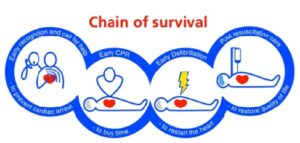
The Chain of Survival
Survival from cardiac arrest depends heavily on the “Chain of Survival”, a recognised process promoted by the Resuscitation Council UK, which includes:
-
- Early Recognition & Call for help
- Early CPR
- Early Defibrillation
- Post Resuscitation Care
- Recovery
The earlier each stage begins, the greater the chance of survival.
Final Thoughts
At P3 First Aid Training, we are passionate about delivering realistic, engaging and meaningful first aid education built around real-world operational experience.
We use PowerPoint presentations where appropriate, but only as prompts – never as substitutes for genuine contextual learning.
Our aim is simple:
To help ordinary people develop the confidence, understanding and practical skills needed to step forward when somebody’s life depends on it.
Because when cardiac arrest happens, doing something is always better than doing nothing.
Learn More About Realistic First Aid Training
To learn more about our practical first aid courses, workplace training and CPR/AED sessions, visit:
Or contact us directly:
-
- Telephone: 0161 399 1686